
Disclaimer: Originally written as a submission to the 2026 ACX book review contest. I decided to post it on my personal Substack, but it was too long for one post, so I split it up and edited it a bit. The translations of Bellum Catilinae are mine, and I am an amateur Latinist at best. There may be some errors.
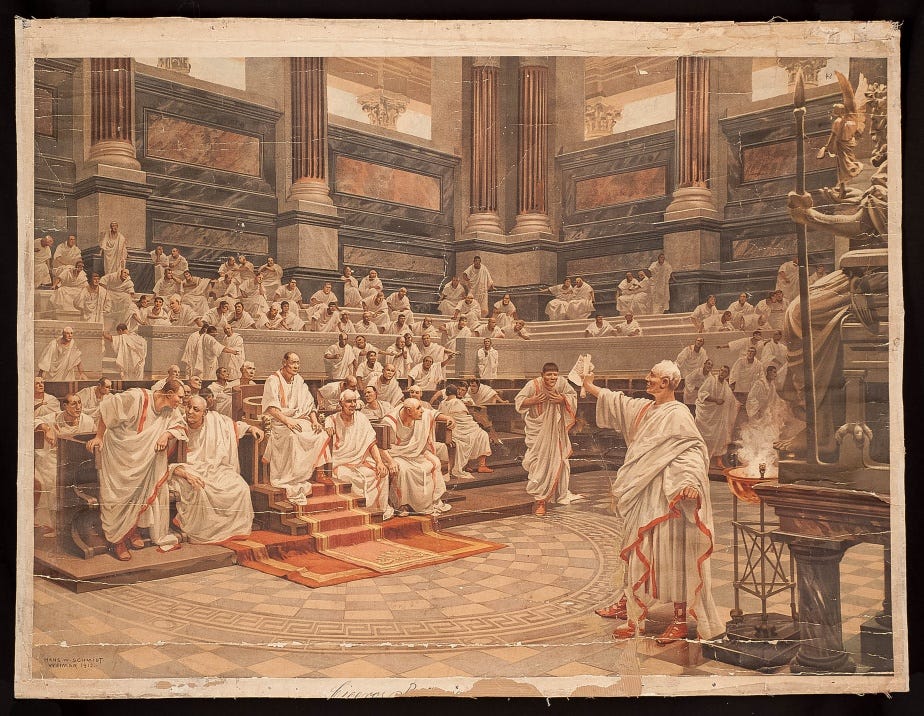
In the first part of this essay, we reviewed the author of the Bellum Catilinae, Caius Sallustius Crispus, and the first half of his magnum opus, about 10% of which I copy-pasted into my article. We looked at his life and voice, and in particular, we examined the first speech that his monstrous villain Catiline gives to his followers. I posited that Sallust’s suspicious even-handedness in his treatment of Catiline—whom he accuses of murdering his son, raping the Vestal virgins, pretty much every heinous crime a Roman can think of—is half because he’d be embarrassed to write a bad speech, and half because he basically agrees with Catiline. If you haven’t read the first part, you can do so here:
A Most Excellent Design, Too Violently Pursued: The Catiline Conspiracy, Part I

Disclaimer: Originally written as a submission to the 2026 ACX book review contest. I decided to post it on my personal Substack, but it was too long for one post, so I split it up and edited it a bit. The translations of Bellum Catilinae are mine, and I am an amateur Latinist at best. There may be some errors.
But I think there’s more under the surface.
Part II will argue that Sallust’s history is not quite history as we understand it today, or at least, that the motivations behind writing are alien to us, and this colors the work in alien shades. Sallust is a Roman, 2000 years and many cultural revolutions removed from us, with a different worldview and a different mindset.
We left off right as Catiline finishes his peroration, having convinced his fellow misfits to follow him on the treacherous path of revolution.
Entrapment, and Catiline’s Rubicon
Following his great speech, Catiline then passes around a cup of human blood. Sallust hedges this claim, but like most Roman historians, cannot resist a good story.
Some, at that time, said that Catiline, after giving his speech, drove his criminal accomplices to take a solemn oath, by passing around human blood mixed with wine, in a sacrificial cup. And for this reason, [Catiline] repeatedly asserted that he did this so that there would always be the greatest faithfulness between them, because each was conscious of the other’s crimes.
Some considered this a fiction, and much else besides, coming from those who, jealous of Cicero who afterwards ascended to power, believed that he [Cicero] inflated the atrocious criminality of those whom he punished.1 To us, in view of its great moment, too little has been discovered of this matter. (Bellum Catilinae 22)
Unfortunately for Catiline, while he and his fellow misfits are busy drinking blood, his conspiracy is falling apart.
Catiline’s perfidious Gallic allies, not so sanguine about Catiline’s chances, along with some turncoat informants, tell Cicero everything. The spooked senators cause the comitia to elect Cicero consul, despite Cicero’s execrable nouveau riche status. Cicero then sets up a sting, involving an exciting night ambush on a bridge, and arrests some of the conspirators. The atmosphere in Rome turns toxic with suspicion after the arrests, due to the magnitude of the conspiracy. Cicero is named “father of his country” for services rendered.
Catiline himself, however, escapes to his army in the provinces, and not a one can be convinced to betray him, though his army is composed of robbers, bandits, and slaves:
Despite two senatorial decrees, not a single person, out of so many, could be bribed to expose the conspiracy, nor could be convinced to desert Catiline’s army camp. (Bellum Catilinae 36)
Scholars are split on whether any of this actually happened. Did Cicero genuinely uncover a sinister plot and quash it, or did he invent a conspiracy for his own political gain, driving Catiline to armed rebellion in self-defense? Sallust half-endorses this position. For my part, I read it as somewhere in between. Catiline is just the latest in a long line of armed populist reformers, from Tiberius Gracchus to Julius Caesar. The sentiment is clearly real, the conspiracy likely overblown.
Metalepsis and Latin Translation
Nevertheless, we reach the centerpiece of Bellum Catilinae during the trial of the conspirators: a pair of opposing speeches, first Caesar, then Cato. Together the two speeches run roughly 15% (!) of the book, and provide a window, darkly, into the mind of a Roman.
Before we quote from the first speech, I want to make a point that works best in the original Latin.
Let’s look at the opening line of the book:
Omnis homines, qui sese student praestare ceteris animalibus, summa ope niti decet, ne vitam silentio transeant veluti pecora, quae natura prona atque ventri oboedientia finxit. Sed nostra omnis vis in animo et corpore sita est: animi imperio, corporis servitio magis utimur; alterum nobis cum dis, alterum cum beluis commune est.
It befits all men who wish to stand above the animals to strive with all their might, lest they pass their life in silence like cattle, whom nature formed groveling, belly-slaves. No, all our power rests in mind and in body—it is best when the mind rules and the body obeys, the first like unto gods, the second, to beasts. (Bellum Catilinae 1)
Next, from Caesar’s (upcoming) speech to the Senate:
Omnis homines, patres conscripti, qui de rebus dubiis consultant, ab odio, amicitia, ira atque misericordia vacuos esse decet. Haud facile animus verum providet, ubi illa officiunt, neque quisquam omnium lubidini simul et usui paruit.
It befits all men, Conscript Fathers [Senators], who deliberate on uncertain matters, to be free of hatreds, friendship, anger and compassion. The mind discerns truth with difficulty when obstructed by these things, nor has anyone ever simultaneously served both his passions and his best interests. (Bellum Catilinae 51)
Both sentences begin with Omnis homines—an archaized spelling of omnes, fronted for emphasis—and both use decet, the impersonal verb of propriety, “what is fitting.” They universalize what is appropriate for a Roman man; Jane Austen would write “It is a truth universally acknowledged…”
I took one liberty with word choice here: “belly-slaves.” Prona atque ventri oboedientia literally translates as “[lying] prone and obedient to the stomach,” but the sense is contemptuous and the rhythm punchy, so I decided to render prona as “groveling” (following the 1921 Loeb edition), and ventri oboedientia with an Anglo-Saxon compound.
Beyond the clear sentence-level similarity are parallel themes: Caesar’s lubidini, lust for power or riches, contrasts with usui, that which is “of use” or in one’s best interest, parallels the opening’s animi imperio, corporis servitio magis utimur—it is better when the mind rules and the body obeys.
The similarities are intentional. This is a technique called metalepsis, a deliberate blurring of the history and its subjects; Caesar, and later Cato, engage directly with the themes of Sallust from within his book. We should expect, therefore, that these two speeches serve some purpose for Sallust beyond accurate recordkeeping (beyond their sheer length).
On to the speeches themselves.
The Clementia of Caesar
Caesar speaks first, and his argument is strikingly modern.2 He argues for clemency on precedent. Roman law does not permit summary execution; to break precedent here is to set one foot on the slippery slope.
In the Macedonian War, the great and magnificent city of Rhodes, with a flourishing population (due to our help!), behaved treacherously towards us. Yet after the war was won, there was a discussion about the Rhodians’ fate, and our ancestors dismissed them unpunished, so that no one might say that they began the war for revenge, or for money… Our ancestors constantly concerned themselves with what conduct was worthy of their dignity, not what could be justly inflicted on their enemies.
This I see for you all, Conscript Fathers, lest the crimes of Publius Lentulus and others carry greater weight with you than your own dignity, and you be swayed more by your anger than your good names. If a just penalty for their crimes can be found, I will approve a departure from precedent, but if the magnitude of their crimes exceeds our capacity, I think only that should be done which laws already provide for.
Whatever befalls them is deserved, but moreover, Conscript Fathers, consider what you inflict on others. All evil deeds arise from good intentions. And indeed, when command falls to cowards or lesser men, a new standard arises, moving from that which is worthy and appropriate to unworthy and immoderate… In living memory, when the victorious Sulla ordered Damasippus, and others who had risen by doing evil to the Republic, to be strangled, who among us did not praise him? It was said that men, both criminal and conspiratorial, who plotted sedition against the republic, were deservedly killed.
Yet these crimes were the beginning of a catastrophe, because henceforth whenever anyone coveted a house or villa, or later, even a vase or someone’s clothes, Sulla saw to it that he too was numbered among those proscribed. Thus those who had celebrated Damasippus’ death, only a little afterwards were themselves dragged off, nor did the slaughter end before Sulla had entirely glutted his own supporters with stolen wealth…
For my own part, I do not fear this from Marcus Tullius [Cicero] or for these times, but in a great commonwealth there are many and varied characters. It could be that at another time, with another consul who also holds an army in his hand, some lie is taken as truth. When the consul, with this precedent before him, draws his sword, who shall restrain him? (Bellum Catilinae 51)
The quality of this speech is no mystery—Sallust loves Caesar, writing good speeches, and sticking it to Cicero. But Caesar’s speech is improbably prescient. What will happen, asks Caesar, the next time a dictator seizes hold of the Republic? Caesar at the time would not have known, but that future dictator is Caesar himself, and Sallust’s audience does know this. Caesar prophesies his own conduct.3
More prosaically, Sallust also allows Caesar to demonstrate the virtues Sallust most wants to enshrine. In addition to being another of the greatest Roman orators of all time, Caesar was famous for his clementia, his mercy to enemies. Both are on display in this speech.
The Austerity of Cato
After Caesar sits, most of the room is leaning towards clemency, but no mercy is to be found in Cato. He speaks next, and calls for the death penalty. His argument is moral: be decisive, act swiftly, save the Republic.
Very often, Conscript Fathers, I have spoken at great length to this body. I have complained of the extravagance and avarice of our citizens, and for that reason made enemies of many men. It is not easy for me to overlook others’ lustful deeds, when I have never permitted those same faults in myself.
Yet, even as you regard my complaints as of little worth, the Republic has stood firm; great prosperity can bear a little negligence.
Now, however, it is not at issue whether we shall live with good or evil customs, nor how magnificent is the empire of the Roman people, but whether these, whatever kind they are, shall belong to us, or to the enemy, and we ourselves with them. And at a time like this, someone mentions gentleness and mercy, to me! I tell you, we lost the true names of things long ago. Now, to lavish another’s goods is called generosity, boldness in evil deeds is called fortitude, and because of this, our Republic balances on a knife’s edge.
Our noblest citizens have conspired to burn out our country. They have summoned the Gauls, most hated foes to the Roman name, to war; the enemy general looms over our heads. Yet you delay, and even now you doubt. What will you do when the enemy takes our walls?
Conscript Fathers, if, by Hercules, there was time for error, I would happily suffer you to be corrected in this matter, since you think so little of words. But we are surrounded on all sides. Catiline presses us at the passes with his army; our enemies are within our walls, in the very heart of our city. Neither preparations nor plans can now be hidden; it is all the more necessary to hasten to action. (Bellum Catilinae 52)
The Senate “extols his virtues to the heavens” (Bellum Catilinae 53), and votes with him.
Forgotten, Like the Beasts of the Field
There is a second level of metalepsis in these speeches, beyond Caesar’s philosophical engagement with his own later conduct, and I think it reveals why Sallust writes history at all.
Sallust allows Caesar and Cato, in whom he admires a disjoint set of Roman virtues, to “fix their memories in the minds of posterity” through his history, lest they be forgotten, like cattle.
The idea of recording history just so that events won’t be lost is modern. Sallust doesn’t think like this; the facts per se are of no importance to him—the people are the focus. Sallust tells us this himself: men of whom nothing is written are not just unimportant to him, they are beasts, whose life and death he holds equally worthless.4 I should be careful not to overstate this, but worthless people being, literally, herd animals is a very steppe outlook for a Roman magistrate.5
This sentiment descends from the grand Indo-European poetic tradition.6 Every grand cultural-linguistic complex has some idea of what makes a man immortal, but the Indo-European daughter civilizations always have a concept that runs through the kleos aphthiton, the glory imperishable, won by the doing of great deeds in the sight of your fellows.
Achilles is the prototypical example, who chose kleos (fame) over nostos (homecoming), and is remembered forever after. The concept shows up unaltered in both the Iliad and the Rig Veda (ákṣitam śrávas).
There is no afterlife in this system worth having.7 Instead it is by doing great deeds, by the poets weaving those great deeds into great epics, and by the poets being paid equally great sums for that epic, that a man may live forever.
Sallust’s description of Cato (rememeber, his patron’s sworn enemy!) is one of the most famous lines in all Latin prose:
esse quam videri bonus malebat
He preferred to be virtuous, rather than to seem it. (Bellum Catilinae 54)
In Caesar, Sallust sees the pinnacle of generosity and mercy, and in Cato, of dignity and austerity. These virtues make them worthy, and Sallust makes them immortal.
Now, his motivations are not quite academic, he wants immortality too:
It is good to serve the republic in deeds, but to serve it in words is not to be despised. Either war or peace allows one to become notable, and in both those who do and those who write what has been done, there is much to be praised. Yet to me, even though by no means does equal glory follow the writer as the doer of great deeds, it appears especially arduous to write history. (Bellum Catilinae 3)
This isn’t him being grasping, or conniving, this is precisely what the Indo-European tradition expects of a bard. It’s an equivalent exchange, or nearly.
Agonal Culture and a Bloody, Mournful Victory
With the conspirators captured and executed, the Senate raises an army and marches it to Catiline’s provincial stronghold. There, Catiline’s irregulars and the Roman regulars have a short war of maneuver, but Catiline is eventually trapped against a mountain, and forced to fight.
Catiline sends away his cavalry, “in order to make his soldiers’ spirits greater by equaling their danger,”8 and personally deploys his infantry, placing himself and his freed slaves next to his Marian Eagle battle standard.
This is a very interesting detail. Caius Marius was a brilliant general, and Sulla’s opposite in the preceding civil war that laid the groundwork for Catiline’s conspiracy. Marius reformed the Roman army9 and defeated the greatest existential threat to Rome since Hannibal.10 He was also a radical populist reformer who seized military control of Rome for a few bloody years right before Sulla did, and became a sort of tyrant-martyr hybrid for the populist cause when Sulla defeated his faction. Hoisting the Marian Eagle is the secular equivalent of Crusaders carrying the True Cross into battle—Catiline is displaying both his allegiance and his legitimacy.
Beneath the Marian Eagle, Catiline delivers his final speech. His cause is doomed, his army outmatched, and Sallust makes it clear that Catiline knows this.
I have discovered, soldiers, that words do not add to courage, nor can a commander’s speech make braves from cowards, nor strength from fear. However much is inherent in each man’s spirit, by nature or customs, so much is laid bare in war.
If you wish to remain here [on the field of battle], you must be daring, for nothing save victory can exchange war for peace. But if you hope to find salvation in flight, when you have turned those arms which shield your body away from the enemy, you are indeed insane. Always in war, the coward is in the greatest danger, therefore trust in boldness, not in walls.
And when I regard you, soldiers, and think upon your deeds, I hold a great hope of victory. Your spirit, your life, your valor lends me strength, and beside those the necessity, which makes brave even the timid… But if Fortune should envy your valor, take care, lest you lose your life unavenged. Nor if you are captured, allow yourselves to be slaughtered like livestock, but die fighting, like men, and leave your enemies a bloody and mournful victory! (Bellum Catilinae 58)
Sallust notes that the enemy commander, assuming Catiline to be a coward, is surprised to see him fighting fiercely in the front ranks. And at the end, when Catiline sees his own forces routed, he makes a wild charge with his retainers “into the crowd of the enemy and was there pierced through, still fighting.”11
Sallust closes the book with a melancholy epitaph for Catiline and his men.
At the battle’s close, it was obvious how much courage, how much strength of spirit, was in the army of Catiline. Because nearly every man who held a position while alive and fighting, covered that spot with his body when dead. A few, indeed, whom the praetorian cohort had scattered, were a little further apart, but the wounds of even these were on the front. Catiline was found far in advance of his men, surrounded by the corpses of his enemies, still breathing slightly, and retaining in his countenance the ferocious spirit that animated him while alive.
In the end, out of the whole force, no freeborn citizen was taken prisoner, either in battle or the flight: they spared their own lives no more than they did their enemies’. Nor indeed did the Roman army take much joy, nor win a bloodless victory: because each of their bravest had been either killed in the battle or grievously wounded as they left the field. Many, who had ventured out of the camp to visit or plunder, turning over the bodies of the rebels, found a friend instead. Others found guests or kinsmen; there were those as well who found their enemies. Thus was the entire army shaken with happiness and sorrow, mourning and celebration. (Bellum Catilinae 61)
To us, it is a little odd for a historian to display obvious admiration for a man so “twisted and evil in mind.” Catiline is decidedly not virtuous in the modern sense, murderous youth-corrupting rapist that he (allegedly) is.
But he does have virtus.
Latin has many of these words, with exact modern reflexes and inexact semantic correspondences. Consider the verb rapere. Rapere, from which our word “rape” is derived, literally means “to seize by force” in Latin. It does not necessarily entail sexual violation, because the verb is frequently used for objects. The sexual violation is instead a common connotation in Latin, which usurps the bare meaning in English.
It is the same with hero and virtus. A Latin hero who displays virtus is not necessarily a virtuous hero. Hercules, the prototypical hero absolutely bursting with virtus, goes mad and murders his wife and child, yet Cato, and indeed all Romans, literally swear by him. Hero and virtus are at least skew to goodness in Latin, if not quite orthogonal.
In other words, excellence commands recognition independent of moral status, and a magnificent villain receives a magnificent, worthy death. This is the essence of Greco-Roman agonal culture. Agon in Greek means “contest” or “struggle,” and names the Greco-Roman ideal of competition as a virtue per se, absent moral valence.
This mindset explains much, both in Roman history generally and Sallust’s histories specifically: if glory is found in competition, what glory is there in defeating an unworthy enemy? Roman commanders disdained to prosecute slave revolts for the same reason, because where is the grandeur in killing slaves?12
Caesar, again, furnishes a compelling example. His famous line “veni, vidi, vici” was actually a dig at his rival, Pompey Magnus. Caesar had just defeated Pompey, and wanted to belittle Pompey’s conquest of the East, where Pompey made his name. Caesar implies there was no skill involved: when Caesar also ventured to the East, he came, he saw, he conquered.13
Why does Sallust Immortalize Catiline?
In Part I, I argued that Sallust’s simplest motivation for writing Catiline as a persuasive, sympathetic orator is that he agrees with Catiline on the merits. This does not make Catiline less personally vile to Sallust, but it does make his arguments so.
His second motivation, the love of the game, is also recognizable to us. Sallust is trying to demonstrate his skill, and out-write his rival Cicero, who succeeded in politics where Sallust failed, and whose oratorical style literally defined classical Latin. You see it everywhere: Cicero’s conspicuous absence, Sallust’s deliberately archaic prose and anti-Ciceronian sentences, and my favorite, his (alleged) marriage to Cicero’s ex-wife.
But then his motivations become more culturally contingent, and it gets to the heart of why Sallust writes history at all—and not only Sallust, the same impulse runs through Cato and Caesar’s speeches, through Tacitus, Livy, through the whole ancient tradition. “To speak the name of the dead is to make them live again.” The proverb is Egyptian, but any Vedic poet or Greek bard would feel it in their bones.
We write history to preserve facts and to explain why things happen as they do. Sallust wrote “to fix our memory in that of others as greatly as possible,” to grant a great man immortality.
Virtue, for us, is inseparable from moral character. You see this everywhere. A politician, a great athlete, a professor, a general, whose accomplishments are lauded by all, falls from grace in an instant, due to his infidelity, or his drug addiction. We find it hard to praise his accomplishments thereafter, because we are tacitly endorsing his crimes.
But Catiline’s virtues, for Sallust, are separable from his many flaws: his oratory is first-rate, his personal courage beyond question, and his men die with wounds in front. In a magnificent villain, there is much to be admired, independent of whether that magnificence was concomitant with goodness, too.
The ability to separate vice from virtue in the soul of a man is itself a virtue, one that our enlightened modern age has surely lost. But I am hesitant to uncritically lament its absence. It is to precisely these men, after all, that the Republic fell.
Did you catch the dig at Cicero?
Quite a few things the Romans do and think is strikingly modern, but considering our (America’s) political system is largely based on the Roman one, and intentionally so, perhaps it would. be more correct to say that we are “strikingly Roman.” Then, of course, the topic of infanticide comes up and that familiarity goes out the window. The past is a foreign country.
And again, Sallust writes in the tradition of Thucydides, that great historian of the Pelopponesian War, and considers it perfectly acceptable to invent speeches that are ta deonta, appropriate to the moment.
Sallust follows on to his opening line, about passing one’s life in silence like a cow, with another killer one-liner on the same theme
… many mortals, slaves to stomach and sleep, unlearned and uncultured, pass through life like strangers. To those, against nature, the body is a delight and the mind a burden. Of such men, I esteem their life and death the same, since the record is silent on both. (Bellum Catilinae 2)
There is lots of steppe residue in Latin, if you look. Pecunia, wealth, derives from pecus, livestock. We shouldn’t overstate the influence of Indo-European heritage, though it is absolutely there, in the cultural substratum and in the language especially. See for example, the weird origins of Valentine’s day via Lupercalia, the very ancient Roman festival where hordes of howling, naked young men beat nubile women with bloody sheepskins to encourage fertility.
...many of the noble youths and of the magistrates run up and down through the city naked, for sport and laughter striking those they meet with shaggy thongs. And many women of rank also purposely get in their way, and like children at school present their hands to be struck, believing that the pregnant will thus be helped in delivery, and the barren to pregnancy. (Plutarch, Life of Caesar)
I haven’t read it, but this book Wolves of Rome looks interesting, if you’re into that sort of thing:
Sallust inherits this tradition in two ways, directly from his Latin forebears, but also sideways, via Thucydides and the rest of his Greek role models in writing history.
No winning words about death to me, shining Odysseus!
By god, I’d rather slave on earth for another man—
some dirt-poor tenant farmer who scrapes to keep alive—
than rule down here over all the breathless dead.—Achilles, to Odysseus. (Homer, The Odyssey 11)
Bellum Catilinae 59
I am obligated to mention that at least some scholars dispute this: https://acoup.blog/2023/06/30/collections-the-marian-reforms-werent-a-thing/
https://en.wikipedia.org/wiki/Cimbrian_War
Bellum Catilinae 60
This is part of the reason why the famous Spartacus slave revolt was so successful; the political/military class of Rome didn’t consider it worth their time to fight a bunch of slaves. This backfired on them in spectacular fashion. You’d think they’d have learned by this point—the other name for the Spartacus revolt is the Third Servile War.
Conversely, the same mindset explains why the absolute highest honor any Roman can obtain is the spolia opima, the rich spoils, which you give/receive when you personally kill an enemy king in single combat and dedicate his armor to Jupiter Feretrius. Exactly three Romans ever received this honor.